post

Out in Theaters: MANDELA: LONG WALK TO FREEDOM

“Mandela: Long Walk to Freedom”
Directed by Justin Chadwick
Starring Idris Elba, Naomie Harris, Tony Kgoroge, Riaad Moosa, Jamie Bartlett, Deon Lotz, Terry Pheto, Gys de Villiers
Biography, Drama, History
139 Mins
PG-13

Mandela.jpg

Nelson Mandela deserved better than the dour glossary of events present in Mandela: Long Walk to Freedom. Failing to capture the spirit of the apartheid, except in bursts of violence amidst a rotation of disconnected massacres, Justin Chadwick‘s film replaces thoughtful reflection on a cultural epoch with as many headlines events as possible. Idris Elba‘s turn as the titular South African hero is the easy highlight of this otherwise throwaway film but the real motivation of Nelson and wife Winnie Mandela are trapped somewhere in the performances, left on the editing room floor, and never given enough room to breathe and evolve into the epic struggle we know the world around.

The biggest problem Mandela encounters is that it doesn’t seem to know what to keep and what to cut. Running over two hours and twenty minutes, the film is a definitive slog. From seeing Mandela as a young child growing up on the tribal plains of Mvezo to his election as president of South Africa, no detail is spared. Rather honing in on a number of significant events in Mandela’s life, William Nicholson‘s screenplay just blasts every minuscule detail in there. Inevitably, they land with as little impact as possible because of the snapshot nature of their inclusion. Had this host of details been incorporated into part of a larger scheme, or even a Mandela miniseries, this all inclusive tactic may have worked fine and given meaningful chapters to a meaningful life, but within the framework of a two-and-a-half-hour movie, the film feels bloated to the point of bursting.

Mandela_.jpg
Nicholson is no stranger to epics – he wrote the screenplay for Gladiator and Les Misérables – so there’s really no excuse for why the story got away from him. Letting the scope of the picture drive the story rather than the other way around, Nicholson’s script confuses information for intimacy. Instead of spending ample time getting to know Mandela, most of our meetings with him try to inform us of what kind of man he is. Rather than seeing the man in action, we hear about his actions secondarily – all serviced up expecting astonishment but frequently landing with a crunch. As a complete work, it’s closer in kind to Les Misérables wandering structure than Gladiator’s streamlined epic. While Maximus’ journey was a natural progression of events that increased the stakes chapter by chapter until a massively rewarding climax, Mandela’s long walk feels dull and meaningless by comparison. This fact alone is a bit of a disgrace.

Beneath the cake of old man makeup, Elba gives a solid performance as Mandela but he’s unable to keep the rest of the project afloat. He’s got the choppy cadence and regal tone down pat, and it’s nice to him see escape his recent slate of blockbuster supporting roles, but Nicholson’s lackluster script, surprisingly enough, doesn’t give him a ton to work him. For a man who spent 27 years rotting away in a jail cell on Robben Island, few scenes spend time probing the spiritual roller coaster of Mandela’s evolving psyche.

Mandela-Long-Walk-to-Freedom-Idris-Elba.jpg
Shifting from lawyer to outlaw, man to message, “terrorist” to president – and always trying his best to remain a peacemaker – the Mandela onscreen remains largely the same. For all the heated ideas of revolution stirring, we’re in the back corner wondering when all this chatter will die down so we can actually dig into the man’s mind. Instead, we are forced to take any “transformation” at face value. We’re frequently told of a man changed but there’s little supporting evidence for these bold claims of metamorphosis. This is a man considered by many to be next to sainthood and yet it feels like he hasn’t grown a day in the 80-odd years we see him onscreen.

Although not helped a lot by the words on the page, Naomie Harris flounders as Nelson’s wife, Winnie Mandela. Screaming and shrieking her way through most of her lines, she is a character with a very clear transformation but it all takes place behind some mystical curtain. Audiences in search of understanding will be largely disappointed as we never see the stepping stones leading from Winnie 1.0 to Winnie 2.0. She shifts overnight, in the shadows, robbing us of any semblance of understanding, meanwhile rendering the film even more vanilla for its unwillingness to dissect a controversial character.

mandela-long-walk-to-freedom02.jpg
Obviously the makers of this film had nothing but good intentions in the making of Mandela but the fact of the matter is not everyone can get a gold star for effort. Their goal is appropriate; to bring a balanced biopic with equal measures of entertainment and education; but it just never comes to fruition, it never follows through on its promise. In their textbook approach, they’ve lost the majestic sense of wonder we come to expect of a film. Sidelining a succinct story arc for tell-all testimony, Mandela is designed to be played by substitute teachers in History classes across America for the next decade. It’s unlikely to have much staying power beyond that.

Nelson Mandela was a man who championed compromise, so maybe this is a suiting film for his legacy. Instead of being deeply entertaining or deeply informative, it lands somewhere in the middle, compromising depth for surface level knowledge and sidelining deserved dramatic beats for melodrama. Instead of being a really good chapter of Mandela’s life, Mandela: Long Walk to Freedom is little more than the Nelson Mandela Spark Notes.

D+

Follow Silver Screen Riot on Facebook
Follow Silver Screen Riot on Twitter


post

Out in Theaters: PHILOMENA

“Philomena”
Directed by Stephen Frears
Starring Judi Dench, Steve Coogan, Sophie Kennedy Clark, Mare Winningham, Barbara Jefford, Michelle Fairley, Peter Hermann, Sean Mahon
Drama
98 Mins
PG-13

Philomena_Poster.jpg
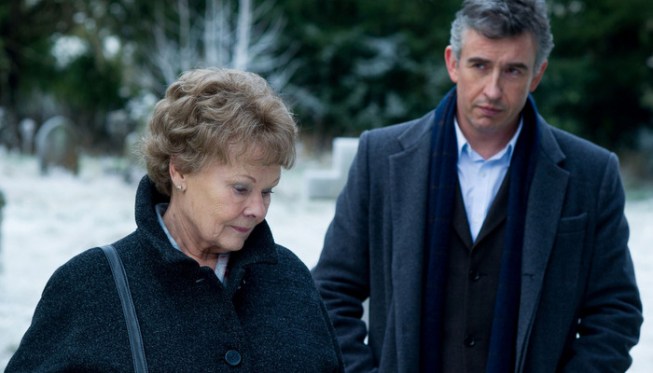
Philomena Lee’s true story is the stuff of nightmares. Her baby stolen away by nuns and sold to the highest bidder, the path to that forfeited son swept clean, locked inside the tight-lipped vault of one particularly malevolent Catholic nun, Philomena has been through hell on Earth. And yet, she won’t condemn those who have brought so much suffering upon her. Instead, she passes absolution down like Jesus himself. She may not ever forget but she is willing to forgive and from her untainted spirit, we can all learn a valuable lesson.

In Philomena, Martin Sixsmith’s not quite disgraced but he’s been let go from his cushy position over at the Labour party. Unsure where to start on his long-gestated novel of Russian history, he’s offered a chance to turn Irish elder Philomena’s life story into a personal piece by an old friend editor, Sally (Michelle Fairley). Intent on maintaining his journalistic pride, he refuses to touch her story on the grounds that it’s a human interest story and “human interest stories are read by weak-minded, ignorant people and written by weak-minded, ignorant people.” But when Martin meets Philomena, he is equally captivated by the unspeakable calamity that she’s just now opening up about for the first time in sixty years.

Philomena_4.jpg
Judi Dench
 drops the crusty but caring shtick she’s perfected over the course of her career to embody this foundation of life of a woman. Bubbling over with enthusiasm and accidental wit, Philomena is like Pinocchio – a wooden figurine  magically brought to life who, now finally living, can’t stop ogling at the wonders of the world. As she hops around the globe with Martin trying to unearth the mystery of her lost son, she lives out the childhood she never had, a childhood she spent slaving away at a nunnery. Even though Philomena’s story is a tragedy, she prefers to think of it as a work in progress, a perspective guided by her unflinching glass-is-half-full optimism. Though initially mocking Philomena’s rose-colored perception of the world, Martin begins down his own road of internal modulation that may turn around his raincloud ways.  

A zesty screenplay from star Steve Coogan adapts the real Sixsmith’s “The Lost Child of Philomena Lee” balancing doses of meaningful character drama amongst potent religious commentary and stark moments of comedy. His acid wit underscored with her tender naivety, they are the quintessential odd couple.
 
Philomena_1.jpg
But as the film pokes along, it only really finds its footing when Philomena emerges as a comic presence. Her unexpected sexual asides catch the audience off guard and proves that there may be more behind her mousy-mopped facade than we expected at first glance. And once this Philomena as comic is out of the box, anything less from her feels flat – a sour disappointment.

Moving from one act to the next, the film begins to feel fundamentally disjointed. The first act is moody and glum, a mirror of the cloud-raked weather of their London setting. The second Washington D.C.-set act reveals newfound buoyancy after discovering the humor of the piece. But comedy is interrupted by tragedy and by the time the third act rolls around and we wind up in Ireland, the inflammatory and revelatory conundrum we’re put in finds both audience and characters doing a bit of a ballet on eggshells.

Philomena_3.jpg
We want to stand in Martin’s corner, lambasting the outrage of it all but we can’t help but marvel at Philomena’s incredible gifts of serenity. She’s the one who has been wronged and yet she is the only one capable of Biblical forgiveness. “I don’t want to be like you,” Philomena says, “I don’t want to spend my life hating people.” Hers is a power message to be sure but I’d be damned if it all the injustice doesn’t make you want to jump up and strangle someone.

Controversy stirred up by the MPAA and the Weinstein Company over the film’s rating – it was originally R but contested and changed to PG-13 – may have been a play to put this film more in the public eye but it’s clearly not a film that many youngsters will find much interest in. It’s thoughtful, sweet, and even challenging at times but it’s far from exciting and even tetters on the edge on boring at times.

Stephen Frears‘ effort is good at twisting our emotions but it’s not always clear which way he wants to twist them. Whether or not he’s intended to leave his audience feeling muddled and unsure, that is what he achieves. There’s tightly packed power packed in Philomena but I’m not entirely convinced that Frear knows where to aim his punches.

B

Follow Silver Screen Riot on Facebook
Follow Silver Screen Riot on Twitter

post

Out in Theaters: NEBRASKA

“Nebraska”
Directed by Alexander Payne
Starring Will Forte, Bruce Dern, June Squibb, Bob Odenkirk, Stacy Keach, Mary Louise Wilson, Kevin Kunkel
Adventure, Drama
115 Mins
R
nebraska_xlg.jpg
Nebraska
starts with the old school painted mountains of the Paramount logo, a veiled reminder of the golden days of the USA, and jumps into an austere black-and-white landscape of Montana as Bruce Dern‘s Woody Grant stumbles down the snowy strip of government manicured grass between some train tracks and a largely vacant highway. Convinced he has won a million dollar prize, Woody’s intent on claiming his winnings in Nebraska even if that means walking the entire eight hundred mile trip on foot. A reminder of how off the tracks his life has veered, Woody sees his not-too-good-to-be-true grand prize as a means to a life he never had – a golden ticket to meaningfulness and utility long lost.

Reinvention is not that simple though, a fact illustration by the simple reality that Woody’s prize is very clearly a scam – the stuff of Mega Sweepstakes mailing centers intent on pawning off China-made trinkets or magazine subscriptions. His family knows the truth of this hollow sham and treats his bullheaded demand to head southeast as a warning sign that he might be more than ready for a retirement home but Woody remains steadfast in his plans for great fortune.

nebraska_0.jpg
Not ready to admit that his dad may have one too many screws loose, David (Will Forte) knows that there is nothing to come from Woody’s scam of a prize slip and yet agrees to take his grumbling father to Nebraska as a sort of last hurrah, a goodbye bonding road trip – a final way to spend some time with his seemingly fading pops. Along the way, they stop off at Rushmore where the cantankerous Woody hysterically riffs on America’s great monument (“It doesn’t look finished to me”) before then misplacing his teeth along, yet another, set of railroad tracks. Buzzing along towards impending disappointment, the camera eyes static horizon shots, with endless stretches of bleak farmland serving as visual commentary of the washed up wasteland that industry America has become. It’s left in its place a black-and-white relic of the once prosperous plains.

In these bowels of middle America, Alexander Payne finds sidesplitting humor in banality. Scenes of awkward family tension are as side-splittingly funny as watching people on their deathbeds count their many losses is tragic. Seeing how dreams wither and disappointment sets so deep in your bones it becomes indistinguishable from your DNA may prove too heavy a task for those seeking a sunshine and smiles kind of ride. No matter how jet-black the comedy and how biting the drama, it’s the careful balance of the two that makes Payne’s admittedly glum work shine so bright. Searching for the pot of gold at the end of the rainbow, Woody, and by extension Payne, sees tomorrow as an unwritten page.

nebraska_3.jpg
Woody is a man of principles, no matter how skewed they may be and how stubbornly he sticks by them. He drinks too much and is a champion of his own independence (even though at this rate he will most like be on a Depends regiment in the next few years) but it’s clear that he is not a man who can live on his own. Enter wife Kate Grant. The realist ying to Woody’s eternally confused and tragically hopefully yang, June Squibb‘s Kate is the foundation for both Woody as a character and Dern as a performer. Without her blunt tell-em-as-it-is attitude, his blundering air-headed status would lack grounding.

Surly and confused as he may seem, Woody is more than meets the eye though, a fact that David learns when they visit Woody’s hometown. As people catch wind of Woody’s “good fortune” and flock to him looking for handouts, we see the real Woody as he welcomes family and friends coming out of the woodwork to beg like smiling buzzards. And as Woody claims his 15 minutes of fame, we also begin to realize that for all of his knuckle-headed nincompoopery, he’s a man who gives without regard, all brought to life by Dern’s hilarious and heartbreaking performance.

nebraska-2.jpg
For this leading role, Dern is poised for some serious recognition. Even if he misses an Oscar shot (2013 has quickly become an extremely crowded year for Best Actor), he’s secure in nabbing nominations for the Indie Spirit Awards, Emmys and the like. There are few that would disagree that he’s earned it. And although her role isn’t as immediately noticeable as Dern’s, June Squibb has us convinced from moment one that she is Kate Grant. Foul-mouthed and sassy as she is heavy-set, she waddles her way to an inevitable showcase of Oscar moments and should be counted amongst those assured a nomination for Best Supporting Actress. For this part, Will Forte too becomes more than just a comedian. Although he’s the rock from which these other performers vault, his own performance is reined in and earnest – the mark of an actor who has matured greatly since his tenure as MacGruber at SNL.

Rolling sharp comedy and painstaking commentary into one is no easy task, but it’s one that Payne has all but mastered. Nebraska may not be as biting and manic as Sideways or as graceful and beautifully filmed as The Descendants but it has a life and energy all of its own, one that, much like Woody, is entirely unpredictable.

A-

Follow Silver Screen Riot on Facebook
Follow Silver Screen Riot on Twitter

post

Out In Theaters: DELIVERY MAN

“Delivery Man”
Directed by Ken Scott
Starring Vince Vaughn, Chris Pratt, Cobie Smulders, Andrzej Blumenfeld, Bobby Moynihan, Britt Robertson, Jack Reynor, Dave Patten, Adam Chanler-Berat
Comedy
103 Mins
PG-13

delivery-man-poster1.jpg

Whether our viewing sensibilities are just outgrowing Vince Vaughn or people just aren’t writing good showcases for him, it is undeniable that his career is not what it once was. Wedding Crashers came out eight years ago. Let that sink in. I’m of the opinion that the problem has been the material. Ken Scott directs the remake of his own 2011 film Starbuck, which provides an avenue for Vaughn to branch out a little from his typical snarkiness. The result is a surprisingly heartwarming film, if not a bit on the forced side. With some serious revisions, this could have been a great film.

 Comedies these days have such farcical plots that you have to just roll with it. If the idea of a man being hunted down by over a hundred of his own illegitimate children doesn’t instantly set off your BS meter, you can probably handle Delivery Man’s multitude of plot holes, inconsistencies, and “yeah right” moments. In reality, the contract of an anonymous sperm donor is rock solid. In the world of Delivery Man, however, David Wozniak has to deal with the fact that 142 of his 500 plus sperm donations are suing to know his identity. On top of this, he has to deal with becoming a “real” father as he accidentally knocked up his on-again-off-again girlfriend.

Delivery_Man1.jpg

After Vaughn learns the identity of the lawsuit children, he takes to stalking them and playing guardian angel. Stalking one of his “daughters”, he defends her from catcalls. For a musician “son”, he encourages donations to his street performances. One particularly offensive thing is the way Scott portrays a daughter who overdoses on heroin. Vaughn has the opportunity to send the 17-year old addict to rehab, but instead chooses to take it on faith that she can handle it herself, making it painfully obvious that Scott has never dealt with drug addiction in any capacity. For anyone reading this, in case you didn’t know, send them to rehab. Disappointingly (for the films own potential), she keeps her word to this man she has never met before, presumably kicking her nasty drug habit and becoming a tax-paying citizen overnight. What a great opportunity to teach Vaughn’s character a harsh lesson about parenthood wasted.

Parks and Recreation star Chris Pratt plays opposite Vaughn, as his comically stupid lawyer friend. Their exchanges are often hilarious, but still fail to carry the necessary weight, given how much screen time they take up. Pratt brings much of the films comedy, but might conflict a little too much with the realism of the film. It seemed the writers could not decide whether to make Pratt the responsible one of the duo, or to make him Homer Simpson. He alternates between the two, but plays both roles well. In some scenes, he gives lucid legal advice to Vaughn, while other scenes show him being entirely cartoonish. It may be a nitpick, but it just shows another symptom of a sloppy screenplay, that such a crucial character is not entirely focused. His childlike demeanor in the courtroom scenes exist to show just how open-and-shut this case is.

Delivery_Man2.jpg

Vaughn’s character also owes 80 grand to some seedy folk, adding a sense of urgency to the film that feels artificial. This is basic screenwriting 101 stuff. A plot device like this should be more ingrained within the film. It ends up being his reason for countersuing the sperm donation facility for defamation. Wouldn’t greed be a much more interesting motivator, though? Also, this falls flat because the stakes of his trial aren’t that serious. There should be some consequences when his children find out who he is. Instead, they are joyous and relieved. This is all fine and good for the feel-good factor, but I wanted some more authenticity added to the stakes.

In the end, Delivery Man doesn’t quite have the comedic chops to be a great comedy, nor does it have the dramatic chops to be a great dramedy. And that is the problem. No matter how much I was enjoying the movie, I just felt it wasn’t something I would ever want to come back to. When I think of any film that I love, I think of those classic moments, moments which were sorely missed in Delivery Man. Still, there are a lot worse films in theaters right now and this one is quite enjoyable.

C

Follow Silver Screen Riot on Facebook
Follow Silver Screen Riot on Twitter
 

post

2013 Graded A+ To F

Grades.jpg

From A+ to F, the best and worst of 2013 (ranked by grade.)

Her
A+

12 Years a Slave A+
Before Midnight A+
Dallas Buyers Club A+
Lone Survivor A+

All is Lost A
Captain Phillips A
Fruitvale Station A
What Maisie Knew A
This is the End A
Only God Forgives A

Inside Llewyn Davis A-
The Hunt A-
Out of the Furnace A-
Nebraska A-

Prisoners A-
Gravity A-
Frances Ha A-
Short Term 12 A-
Blackfish A-
The Spectacular Now A-

August: Osage County B+
Frozen B+
Laurence Anyways B+
Rush B+
Mud B+
The Place Beyond the Pines B+
Popularie B+

Oblivion B+
Stoker B+
Man of Steel B+
Elysium B+
The Conjuring B+
The World’s End B+ (No review)

Sightseers B
Philomena B
Thor: The Dark World B
About Time B
The Counselor B
Wadjda B
Trance B
Evil Dead B
Side Effects B

You’re Next B
Crystal Fairy B
The Wolverine B
Somm B
Upstream Color B
Machete Kills B (Evan)
Eden B (No review)
Scenic Route B (No review)
Drinking Buddies B (No review)

Enough Said B-
Don Jon B-
The East B-
Iron Man 3 B-
Much Ado About Nothing B-
The Bling Ring B-
Wish You Were Here B-

Turbo B-
Blue Jasmine B-
World War Z B- (No review)
Fast and Furious 6 B- (No review)
The Croods B- (No review)
Behind the Candelabra B- (No review)
Blackbird B- (No review)
We Steal Secrets B- (No review)

Saving Mr. Banks C+
Grabbers C+
The Hunger Games: Catching Fire C+
Blue is the Warmest Color
C+

The Book Thief C+
Man of Tai Chi C+
Kill Your Darlings C+
We Are What We Are C+
Pain and Gain C+
Warm Bodies C+
The Great Gatsby C+
Mistaken for Strangers C+
Kings of Summer C+

We’re the Millers C+
The To Do List C+
Unfinished Song C+
Kon Tiki C+
(No review)
Room 237 C+
(No review)

Ender’s Game C
Star Trek into Darkness C
Ain’t Them Bodies Saints C
The Way, Way Back C
In a World C
Bad Grandpa C
Europa Report C
The Sapphires C (No review)
I’m So Excited C
(No review)
The Iceman C
(No review)
Monsters University C (No review)
Kickass 2 C (No review)
Antiviral C (No review)
Disconnect C (No review)
The Purge C (No review)
Twenty Feet From Stardom C (No review)

The Hobbit: The Desolation of Smaug C-
Byzantium C-
Runner Runner C-
Carrie C-
Cloudy with a Chance of Meatballs 2 C-
A Hijacking C-
Despicable Me 2 C-
The Grandmaster C-
The Incredible Burt Wonderstone C-
Maniac C-

The Summit C- (Kyle)
Cockneys Vs. Zombies C- 
(No review)
Beautiful Creatures C-
(No review)
Olympus Has Fallen C- (No review)
Dead Man Down C-
(No review)

Mandela: Long Walk to Freedom D+
R.I.P.D. D+

Insidious: Chapter 2 D+
Spring Breakers D+
42 D+
Riddick D+
The Heat D+
Closed Circuit D+
Pacific Rim D+

Best Man Holiday D+ (Kyle)
Romeo and Juliet D+
(Kyle)
Mama D+

Now You See Me D+ (No review)
Lords of Salem D+ (No review)

Epic D
Diana D
White House Down D
Parkland D
Last I Heard D
The Lone Ranger D
V/H/S 2 D
21 and Over D

Escape Plan D (Evan)

Identity Thief D-
Getaway D-
Movie 43 D-
Oz: The Great and Powerful D-
The Hangover: Part 3 D- (No review)

The Host F
The Canyons F
The Fifth Estate F
All the Boys Love Mandy Lane F
The Mortal Instruments: City of Bones F
Prince Avalanche F

After Earth F

Follow Silver Screen Riot on Facebook
Follow Silver Screen Riot on Twitter

post

2013 Latest Grades For Quick Scanning Grade Surfers

2013-Calendar-001a5.jpg


The latest full reviews for your reading pleasure.

This Month:

Inside Llewyn Davis A-
Saving Mr. Banks C+
The Hobbit: The Desolation of Smaug C-
Her A+
Out of the Furance A-
Mandela: Long Walk to Freedom D+

November:

Frozen B+
Philomena B
Nebraska A-
The Hunger Games: Catching Fire C+
Best Man Holiday D+ (Kyle)
Blue is the Warmest Color C+
The Book Thief C+
Diana D
Thor: The Dark World B
Dallas Buyers Club A+
12 Years a Slave A+
Last Vegas D+
About Time B
Ender’s Game C
Man of Tai Chi C+

October:

Bad Granpa B+ (Evan)
The Counselor B
Wadjda B
All is Lost A
Escape Plan D (Evan)
Carrie C-
The Fifth Estate F
Kill Your Darlings C+
Machete Kills B (Evan)
Romeo and Juliet D+ (Kyle)
Captain Phillips A
All the Boys Love Mandy Lane F

September:

Enough Said B-
Baggage Claim D+
Rush B+
Don Jon B-
Cloudy with a Chance of Meatballs 2 C-
Prisoners A-
We Are What We Are C+
Runner Runner C-

The Summit C- (Kyle)
Parkland D
Gravity A-
Popularie B+
Insidious: Chapter 2 D+
Short Term 12 A-
Riddick D+

August:

Getaway D-
Closed Circuit D+
You’re Next B
Ain’t Them Bodies Saints C
The Mortal Instruments: City of Bones F
Prince Avalanche F
Elysium B+
We’re the Millers C+

July:

Blackfish A-
Crystal Fairy B
Blue Jasmine B-
Fruitvale Station A
The To Do List C+
The Wolverine B
Turbo B-
The Conjuring B+
Only God Forgives A
Pacific Rim D+
Despicable Me 2 C-
The Way, Way Back C
The Lone Ranger D

June:

The Heat D+
The Spectacular Now A-
A Hijacking C-
Before Midnight A+
Man of Steel B+
This is the End A

May:

The Bling Ring B-
Unfinished Song C+
Last I Heard D
Wish You Were Here B-
Star Trek into Darkness C
Frances Ha A-
The Great Gatsby C+
Iron Man 3 B-

April:

Mistaken for Strangers C+
Much Ado About Nothing B-
Kings of Summer C+
The East B-
Oblivion B+
42 D+
Trance B
What Maisie Knew A
Pain and Gain C+
Mud B+
Evil Dead B

March:
Spring Breakers D+
The Place Beyond the Pines B+
Stoker B+

February:
Warm Bodies C+
Side Effects B

Follow Silver Screen Riot on Facebook
Follow Silver Screen Riot on Twitter

post

Out in Theaters: THE HUNGER GAMES: CATCHING FIRE

“The Hunger Games: Catching Fire
Directed by Francis Lawrence
Starring Jennifer Lawrence, Josh Hutcherson, Liam Hemsworth, Woody Harrelson, Donald Sutherland, Stanley Tucci, Lenny Kravitz, Paula Malcomson, Willow Shields, Elizabeth Banks, Phillip Seymour Hoffman, Toby Jones, Jeffrey Wright
Action, Adventure, Sci-Fi
144 Mins
PG-13

the-hunger-games-catching-fire-new-katniss-poster.jpg
Katniss Everdeen may be the girl on fire and Jennifer Lawrence may be Hollywood hot stuff (du jour), but this second installment of The Hunger Games is only slightly smoldering. In fact, the embers have already started to go cold. All the requisite franchise pieces are there to stoke the billion dollar conflagration this dystopian blockbuster is sure to light, but the overwhelming feeling that there is little spark behind the bark leaves us chilled to all this talk of fire.

Katniss and Peeta (Josh Hutcherson) have returned “safely” from the 74th Hunger Games but now they face the red hot wrath of President Snow (Donald Sutherland), who’s now breathing down their necks. Their final act of near-berry-gobbling defiance in the last film has led to stirrings of revolution across the districts. Through Katniss’ willingness to sacrifice herself to preserve her moral scruples, the country stands newly empowered. Unwittingly, Katniss has located a kink in the armor of Snow’s totalitarian society and must now suffer the price.

hunger-games-catching-fire-hutcherson-banks-lawrence.jpg

The seeds of hope Katniss and Peeta have planted, Snow plans to stomp out. He supposes that the country’s cautious optimism towards a new tomorrow can be quelled if Katniss and Peeta maintain the facade of their romance. By making them one of his own kind, they will become symbols of corruption – a constantly broadcast morphing into the upper class. But all of this is predicated on their selling their “true love” like it’s Oprah Winfrey coach hour. Anything that would even suggest their affection is a muse would be the equivalent of open rebellion and would lead Snow to “take care of” both Katniss and Peeta’s families mobster style. When Snow realizes that the country may not turn against the star-crossed apples of their eye, he launches a new scheme that will pit them, and former victors, again each other again. 

In spite of these constant death threats, Catching Fire lacks breathless moments of white knuckle suspense. No matter how many times the dialogue, aided by Sutherland’s ripe delivery, insist that Katniss and her loved ones are teetering on the precipice of danger, there is little to convince us that anyone could actually be offed. In a franchise like this, everyone is too padded to actually face death. No harm will last more than a few hours, no scar will be too deep to heal. We know Katniss has no expiration date as the franchise train booms towards a fourth film and so any threat towards her – or her cohort’s – life feels paper thin.

4-The-Hunger-Games-Catching-Fire-New-Photo.jpg

And while the first film held a flicker of filmmaking as rebellion, everything about this one screams studio control and designed realism. It all feels so reined in, so calculated in its darkness, and so badly wanting to break free of its PG-13 constraints that it can’t help but lose track of the meaning behind the books. In trying to reel in the masses (and their wallets), Catching Fire as Hollywood product is almost exactly what “Catching Fire” as commentary rages against – turning its back on the central message of stoic individualism against the oppressive tyranny of the elite. The hand of the studio is omnipresent – although hardly malevolent – and there seems to be little to no room for creative flair in the directorial department. Again, big business trumps individual spirit.

Sorely missing is Gary Ross’s urgent camerawork and tight closeups that gave The Hunger Games such a sense of realism. Instead of jammed close in on character’s faces and sharing in their ghastly horror, we feel distant, an observer. With edge-of-your-seat scenes largely tabled, Francis Lawrence goes for something much more horrific – a near 12 Years a Slave for kids. One scene depicting poisonous fog is particularly distressing and uncharacteristically grim for a film of this rating. On the brink of being “too dark,” there is little artistry behind the darkness that feels more like “gritty per popular demand.”

Katniss.jpg

Shying away from the close quarters, almost independent film-esque combat of the first flick, the violence in Catching Fire is staged like the many CGI heavy blockbusters of late. Much violence take place offscreen, in a wide zoom, or in rapid, random bursts, making death almost as inconsequential as it is in a Pierce Brosnan James Bond movie. While the first film saw Katniss struggling with the murder of other children, this film sees her adversaries stripped of that very feature that made their slaughter so perverse and unsettling in the first place. Instead, these adult competitors become faceless baddies in another adventure film.

This franchise middle-child also suffers a pretty rough case of inbetweener syndrome, where it only works within the context of a larger story and not as a standalone film. While it propels what began in the first film into the coming finale, it lacks the finesse of a great middler. Without the pure adrenaline of The Two Towers and the tonal twists and turns of Empire Strikes Back, Catching Fire just carries on the torch, readying it for the next billion dollar installment. Although the bleak-o-meter has been cranked up, the stakes remain largely the same: do or die. 

As sets the gears to full throttle for the inevitable two-part conclusion, we ask, “Haven’t we seen this all before?” The skies have darkened and life on Panem is more unbearable than ever but for all the barrels of darkness and grit-drenched scenery, there is familiarity to this racetrack of escalation that we’ve seen in greater franchises (Lord of the Rings, Star Wars, Harry Potter).

fb15efc4-950c-4c9f-a821-f9080b2e8749_ID_D32_13135_R.jpg

But for all of my complaints and griping, The Hunger Games: Catching Fire is still a smarter than average blockbuster. It’s hard to finger where the $140+ million budget went – none of the special effects are noteworthy – but hopefully most of it is going towards the performers, as they continue to be the strongest selling point of this franchise. However, it’s the supporting characters who outshine the love-locked trio. Stanley Tucci is simply a riot (and possibly the best part of the film) and Elizabeth Banks is as wacky and invisible in her character as ever. Even Woody Harrelson‘s haunted alcoholic Haymitch has more depth than before and seems to be more commited to the emotional toil of his role than many of his co-stars. And however lackluster some of the CGI is, the set design gives us a rock solid sense of place and tone.

Finally, fans of the source material will have little to complain about since the book is adapted to the T. But when all is said and done, it’s just not a terribly exciting movie and one which I don’t expect to return to. Really feeling the sting of its “part of a whole” status, Catching Fire is better at blowing smoke than fanning the flames. 

C+

Follow Silver Screen Riot on Facebook
Follow Silver Screen Riot on Twitter

post

Out In Theaters: THE BEST MAN HOLIDAY

“The Best Man Holiday”
Directed by Malcom D. Lee
Starring Taye Diggs, Morris Chestnut, Monica Calhoun, Melissa De Sousa, Regina Hall, Terrence Howard, Sanaa Lathan, and Nia Long
Comedy, Drama
123 Mins
R

The-Best-Man-Holiday-Poster.jpg

The Best Man Holiday is half of a fun Christmas comedy. The other half is a way-too-long, predictable, cliché of a drama. It’s fitting that Malcolm D. Lee is Spike Lee’s cousin, as they are the opposite kind of black filmmakers. Spike’s films focus on social problems and have something to say, while Malcom makes crowd-pleasers. This isn’t to say that there isn’t a place for crowd-pleasing films aimed at aging black women, they’re just not necessarily my cup of tea. If internet demographics are any indications, and you are reading this, it probably isn’t for you either.

That said, the screening I attended was the most packed I’ve ever been to. A crowded venue laughed endlessly, hooted, hollered, and cracked jokes the entire way through, while absolutely eating up Lee’s work, making the experience much more enjoyable. As I have not seen The Best Man, I felt like I wasn’t in on some of the jokes, but the film starts with a summary of the first that did a good job of catching me up. I half expected it to say, “Previously on The Best Man” like a new season of a BET series.

The_Best_Man_Holiday_3.jpg
To be as objective as possible, the first half of this is a clever comedy script, with several good laughs. Every character has a distinct personality, their own agenda, and they riff off each other well. Terrence Howard stole the show in his scenes, playing the comic relief in a film where every character has Whedon syndrome (they are far too clever for their own good). He also provided some of the only enjoyable moments in the awful second half. Taye Diggs returns as Harper, the intellectual writer, desperate for money, who is trying to cash in on his famous football star friend Lance. Of course, every character is ridiculously famous and successful because this film is predicated on pure realism.

Unfortunately, the women in the film are defined by their male counterparts. They exist to mediate misunderstandings and scarcely talk about anything other than men, while also being at each other’s throats over previous sexual encounters with some of their respective spouses. Make no mistake, these characters were written by a man.

The-Best-Man-Holiday-51.jpg
A convention that really needs to go, because it is pure lazy writing, is this: the misunderstanding that would be easily explained away, but the character does not try to explain it or the other party won’t listen. For example, every romantic comedy, where the protagonist gets kissed for a split second by a drunken girl, right as his significant other walks in. She will walk out and he will say, “No. Wait.” But he won’t do anything else. This convention is used three times in this film and every times it is so poorly executed that you see it coming miles away. Making it more disgraceful is how blatant it is. The character literally says, “Wow it would really look bad if so-and-so saw this out of context.”  Gee, I wonder what’s going to happen. The problems inevitably work themselves out, even though the easy explanation never happens.

All of this isn’t enough, as Lee wants to drink your tears. The serious turn in the second half is so laughable that it was like one of those extremely satirical “dramatic” South Park episodes. To call it a spoiler would be as big an insult to your intelligence as calling your inevitable aging a spoiler, but I will refrain. This plot device brings everyone together, making everyone bummed out, before making them eventually triumphant. It wouldn’t be shocking to find out that Judd Apatow was responsible for the final cut of this nonsense.

The-Best-Man-Holiday-Image-03.jpg
Meandering, preachy, and cliché, there is nothing else to say about it. Every serious scene ends with a Terrence Howard line to try and lighten the mood, but it’s not enough in a film stuck dragging its feet in an otherwise pleasant Christmas comedy. The only thing Christmasy about this film, though, are the religious overtones at the end, as some of the characters talk at length about the importance of faith and prayer, while briefly touching on the problem of evil. Other than that, this has more penis jokes and cat fights than any other Christmas movie I’ve ever seen.

I know I’m repeating myself here, but there is really so little about this film that isn’t surface and contrived. If there were more to warrant a merit-based discussion, this wouldn’t be such a scathing review. Hey, though, if you only have 50 minutes and like this kind of humor, catch the first half and read a synopsis of the second. If you loved the first film, you will probably like this, as you probably have a lot more investment in these characters. For a first time viewer, though, it fails to build that bond. It’s one of the few movies I recommend seeing with a crowd. That means it’s bad.

D+

Follow Silver Screen Riot on Facebook
Follow Silver Screen Riot on Twitter

post

Out in Theaters: BLUE IS THE WARMEST COLOR

“Blue is the Warmest Color”
Directed by Abdellatif Kechiche
Starring Adèle Exarchopoulos, Léa Seydoux, Salim Kechiouche, Mona Walravens, Jérémie Laheurte, Catherine Salée, Aurélien Recoing
Drama, Romance
179 Mins
NC-17

Blue-is-the-warmest-color-5.jpg
Before seeing Blue is the Warmest Color, ask yourself: am I interested in seeing two women in the buff pleasuring each other in unprecedented NC-17 fashion? Even if the answer is yes, there’s still a good chance you’ll find yourself squeamish, crunched in a theater surrounded by strangers as two au naturel ladies hump on screen like jackrabbits OD-ing on Viagra. Although Lars Von Trier‘s slated 5-hour sexual odyssey Nymphomania (sigh) will probably outdo anything set to screen here, Blue is the Warmest Color certainly charters new ground in terms of sexual depictions onscreen at this particular moment in time. But regardless of how risqué the scenes of full-blown love making are here, they add nothing to the context of the story and in one fell swoop redefine masturbatory filmmaking.

Don’t get me wrong, I’m all for some girl-on-girl action but I’d much rather experience that in the comfort of my own home rather than sitting next to a 65-year old gawking geyser who’s probably never heard of the internet. All the spanking, rug-munching, and disappearing fingers makes the audience uncomfortable and, it seems to me, that that is not the intention of filmmaker Abdellatif Kechiche. I’m not one to balk at gratuitousness in movies so long as it services the film. Here though, they’re just servicing each other. 

BLUEisthewarmestcolor.jpg
The film centers on Adèle (Adèle Exarchopoulos) and how her sexual self-exploration parallels her growth as a person so it’s no wonder that we are to witness to some of the more carnal of her erotic acts. But by the time we get to these controversial lesbian love-making scenes, the hope is to unearth some kind of new found passion – a natural rigor unlocked from the union with another woman. Kechiche wants his audience to feel the explosive force of their love as we curl into our voyeur’s chair and watch the lovemaking unfold, but this “making love” looks a lot more like banging, and there’s little to “feel” other than a rumbling in your pant’s region. The lengthy scenes to follow are simply pornographic, making this just about the worst movie in the world that you could see with your mother.

Criticism of controversy aside, Blue is the Warmest Color itself stands out for its down to earth look at human relationship and depth of character. However easy it may be for some feeble-brained individuals to simplify Adèle down to the most basic elements of her lesbianism, she is remarkable because of her sexual complexity. More than being straight or gay or bi, Adèle is sexuality as experimentation. A pinch of this, a taste of that, all’s good in her witch’s brew of fleshy exploration. Rather than stick to the narrow road society has laid for expectations of lesbian culture, Kechiche sees his characters as people first and foremost, women second, a gay lastly. No matter what label we adhere to, he says, we are all sexual beings overflowing with desire and helplessly jealous. After all, we’re just human.

Blue-is-the-warmest-color-2.jpg
From her electric blue hair to her eccentric allure, Léa Seydoux‘s Emma’s unorthodox simplicity is a puzzle for Adèle. While Adèle sorts out her way through her world, Emma is steadfast in hers, a statue of self-secure lesbianism. Adèle can’t quite seem to get a read on the doting Emma and her personal brand of traditionalism. They are ying and yang, point and counterpoint – a memento of a familiar relationship we’ve all had. Every time Adèle shies away from watchful eye of the masses, Emma embraces it. As the film winds on, they circle each other, souls intertwined but never blended into one. However close they come, they cannot see the world through each other’s perspective.

Adèle‘s internal confusion is counterbalanced with a wholesome dose of curiosity. She’s eternally insecure, never really willing to commit to one side of herself or another before she’s sampled every treat in the candy shop. Society’s resolute demand for conformity is probably what prompts her to torture herself with thoughts of self-identification. Is she gay? Is she bi? Is she straight? Kechiche’s film says: it doesn’t matter either way. At any rate, it’s the process of trying to fit everything into a box that causes this toxic brand of internal confusion.

Blue-is-the-warmest-color-4.jpg
As Adèle navigates her way down the long path of figuring herself out, we gain incredible insight into the mind of a fence-sitter – a woman gravitating towards that with the strongest pull in the moment. Years pass and Emma’s electric hair fades to cool blue and eventually into a mousey brown mop as Adèle spirals in her own sink of sexual trial and error. We witness the ups and downs, the roots and fading foundations, and see a relationship raw and rounded.

But that intimacy comes with a price as the three-hour time tag is more than enough to drive people away. And for good reason. Adèle‘s introspective saga is complicated but unnecessarily lengthy, another example of excess in a film brimming with it. With 15-minutes or so of pure porn (which has already become more of a talking point than its victory at this year’s Cannes Film Festival) there is more than enough that could have easily been cut to produce a sharper, cleaner film. Sadly enough, it seems that the allure of the NC-17 might be more provocative than the result.

Blue-is-the-warmest-color-1.jpg
Seydoux and Exarchopoulos are so unwaveringly committed to the roles that there is no question as to how far they go to with each other, raising questions about where the line ought to be drawn between method acting and smut. But beyond their bare-bodied romps, they each offer intimate portrayals of flawed characters, embodying their characters with the stuff of masters – suffering their inadequacies and reveling in their joy.

Despite how fleshed out Adèle, Emma, and their relationship are, we still only need to know them so well to get the message and three hours gives us a much larger window than we ever need. Strangely enough, the story was adapted from a graphic novel by Julie Maroh and that probably accounts for the episodic, long-drawn nature of the film. But as this cuming-of-age story goes round and round, monotony sets in and we slowly start to not really care where Adèle and Emma get dropped off.

C+

post

Out in Theaters: THE BOOK THIEF

“The Book Thief”
Directed by Brian Percival
Starring Sophie Nélisse, Geoffrey Rush, Emily Watson, Roger Allam, Nico Liersch, Kirsten Block
Drama, War
131 Mins
PG-13

thebookthiefposter.jpg
It’s not the first time we’ve seen a World War II movie rife with Holocaust themes and the omnipresent horrors of war nor will it be the last, but The Book Thief manages a healthy dose of thoughtful introspection and rock solid performances amidst extraneous narration a la the Grim Reaper. This narrative tactic might have worked fine in book form but in the film only serves to interrupt the sense of immediacy inherent to the lifeblood of film. Death the narrator comes in unannounced to smooth over the rough edges, blunting the emotion impact of sequences that should have been the most shocking and gut-wrenching. Each time the film reaches an emotional apex, Death takes the stage and narrates us through what we ought to be feeling like we’re reading a storybook about pretty ponies.

There is nothing wrong with finding beauty in death (look no further than American Beauty for proof) but this heavy-handed dictation is not the way to go about it. All attempts to undercut the passing of life with this kind of silver-lining holistic circle of life BS just reaps diminishing emotional return and sours the visceral oomph that the actors have worked so duteously to illicit. Blending high-art performances with scribbling story-booking, the prospects of greatness sour like milk in the sun. It’s truly a shame because there are elements of excellence peppered throughout the film and the inherent power of WWII’s history, which is never something to balk at, is explored from an interesting internal perspective.

the-book-thief-DF-06467_rgb.jpg
More than anything, the film could have used a more thorough editorial sweep to really hone in on tonal consistency as some elements, such as the grating voice over, jut out like sore thumbs. Rather than tug us deeper into the emotional climaxes, the premeditated status of “death as inevitability” only serves to only take us out of the moment and draws our attention to the bumbling, childlike side of the storytelling. When the saga should soar, it instead sags.

Based on the 2006 novel that stretches 550 pages long, The Book Thief begins with a slow pan through the billowy smoke of a  train tumbling towards Germany like a black bullet. On that train rides Liesel, a shy illiterate girl, and her younger brother. Before they arrive at their destination, Liesel’s little brother dies, presumably a result of malnutrition sustained during his lengthy journey through the bowels of pre-war Germany, and sets in motion her vibrant and intuitive moral compass. On cue with her arrival to a country on the brink of a wicked social reinvention, the passing of Liesel’s younger sibling is an appropriate welcoming into this darkening realm that will soon breed sorrow and loss.

Although her adoptive mother, Rosa, is at first as stony as a Felsenbeisser, her new foster papa, Hans, is a heart barely dressed in human skin. He radiates love and understanding and quickly takes Liesel under his paternal wing, teaching her to read and cultivating her love of books and knowledge with his subterranean wall-to-wall chalkboard. Just bristling with spindles of affection, Geoffrey Rush is a fountain of warmth as Hans. His performance is perfectly balanced – a potpourri of optimism and grief, empathy and anguish. For as much eternal hope and internal goodness wells within him, he can’t help but recognize society morally melting around him.

6a00d83453b9ca69e2019b00944425970d-pi.jpg
And as cantankerous as foster mother Rosa (Emily Watson) may seem as first, her character arc is one of the most satisfying and nuanced of the film. Even young Sophie Nélisse is quietly magnetic as Liesel, transcending the label of child actress and putting in a performance well beyond her years. As 2013 ends, she ought to be positioned at the forefront of emerging young talent because her work here is nothing less than staggering. As much as we appreciate and empathize with the core supporting characters, it’s Nélisse who guides us through the visceral darkness – a beacon of light in a vacuum of hope.

As antisemitic currents sweep through Germany, Liesel intuitively picks up on the silent horror of a changing ethos. A scene where she is singing an ironically sweet, almost songbird, antisemitic anthem and then halts her warble mid-song picturesquely captures the dawning of a new understanding. All this preaching of hatred, however cloaked in the angelic voices of children, is poison.

bookthief.jpg
But for every two steps forward the film takes in terms of thoughtful impact, it takes one back. Without fail, every time the story peaks, it reveals just how hard it’s trying to invoke an emotional reaction. Miscalculating more for more, the film has an unfortunate tendency to overstay its welcome and beat the dead horse black and blue. The most egregious instance of this comes in the final moment where the film pulls a Return of the King triple ending. Had it ended a scene or two earlier, sans voiceover, it would have been an extremely powerful and poignant statement. As it is, it’s overdrawn and self-defeating. Instead of going out with understated subtlety, it reminds you over and over again of its intention, as persistent as a politician.

Closing the book on this slipshod endeavor, The Book Thief is a film divided against itself. There are many elements of the film deserving of love but director Brian Percival is constantly sucking the wind from beneath his own wings. At once emotionally sound and fiercely melodramatic, the film, had it underwent a quick trip to the reel barber, could have been shaved into something truly excellent. As it stands, it’s modestly good and mildly powerful but lacking the vitality of a more tactful director.

C+

Follow Silver Screen Riot on Facebook
Follow Silver Screen Riot on Twitter